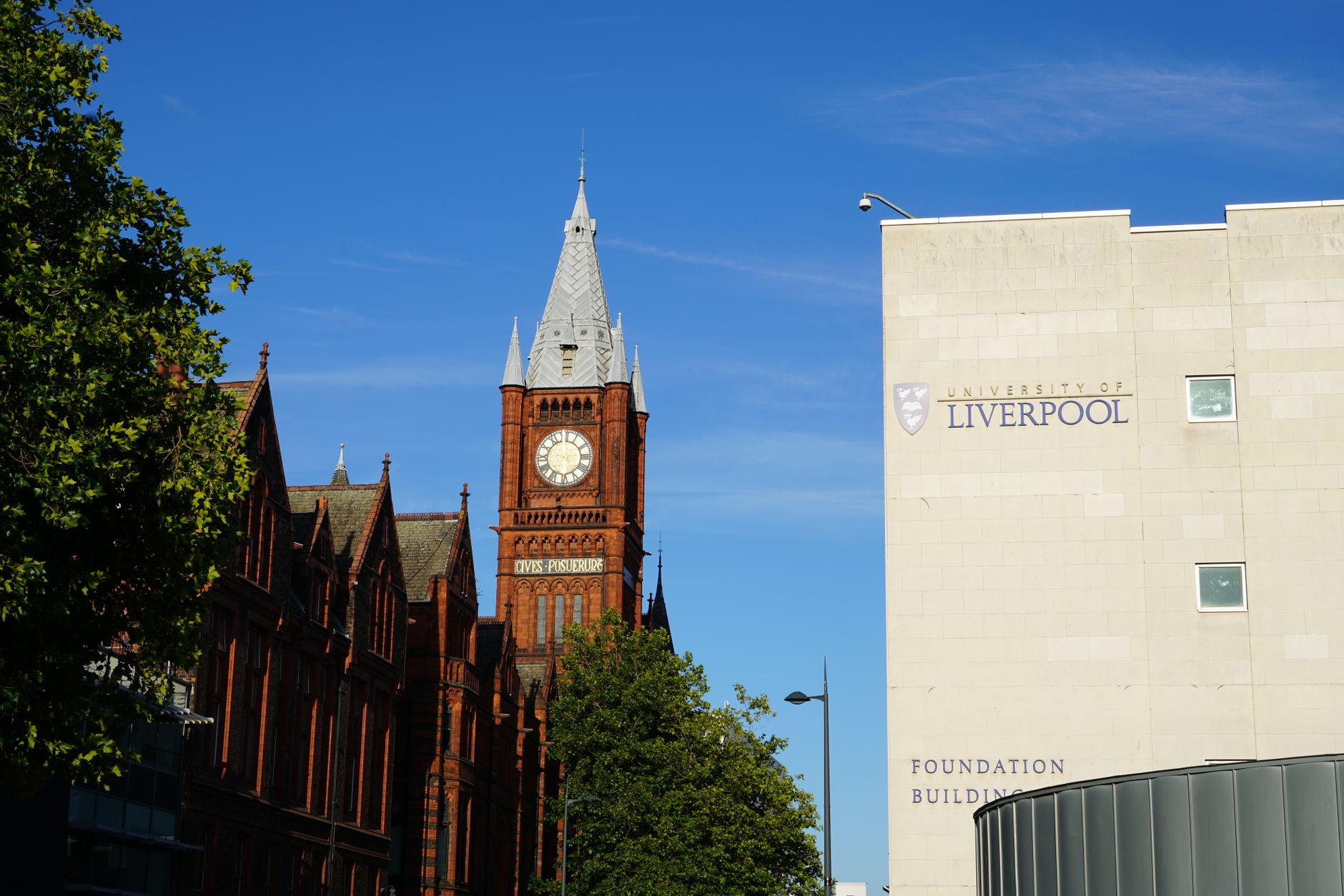
University at a Glance: Why Choose Liverpool
The University of Liverpool, founded in 1881, is one of the UK’s oldest red brick universities and a founding member of the prestigious Russell Group. It sits in the north-west English port city of Liverpool and currently enrols around 30,000 students, more than 30% of them international, from over 130 countries.
In the 2027 QS World University Rankings, Liverpool ranks 176th globally and 26th in the UK. Nine Nobel laureates have been produced in its history, spanning medicine, physics and chemistry. For Chinese students, Liverpool also holds a distinctive advantage: it is the UK partner of Xi’an Jiaotong-Liverpool University (XJTLU), giving it exceptional name recognition in China and a strong alumni network there.
Undergraduate Admissions: Academic Requirements and Standards
Chinese students apply to Liverpool undergraduate programmes through UCAS, with the deadline usually 29 January of the year before entry (for 2026 entry, 29 January 2025). Some courses continue to accept applications after the deadline, but popular programmes fill up quickly, so early submission is recommended.
Academic requirements:
Liverpool accepts Chinese gaokao results for direct entry to the first year of an undergraduate degree. Specific requirements vary by province and programme, but generally the score must reach 75% to 85% or more of the gaokao total. For 2026 entry as an example, most science and engineering programmes require 75% of the total, business and humanities-social science programmes 80%, and highly competitive programmes such as clinical medicine 85% or above.
Students not sitting the gaokao can apply through the following routes:
- A-Level grades: ABB to A*AA for most programmes
- IB diploma: usually 31 to 36 points
- Completion of the first year of a Chinese bachelor’s degree with an average of 75% or above
- Completion of a recognised foundation programme with an average of 65% or above
English language requirements:
Direct undergraduate entry normally requires an overall IELTS score of 6.0 to 7.0, depending on the programme. Most programmes require IELTS 6.5 with no component below 5.5. Law, medicine and veterinary science programmes require IELTS 7.0 with no component below 6.5. The university also accepts alternatives such as TOEFL, PTE Academic and Cambridge English qualifications.
Personal statement and references:
The UCAS application requires a personal statement of up to 4,000 characters covering your motivation, academic interests and relevant experience, plus one academic reference, usually written by a high-school teacher or guidance counsellor.
Postgraduate Admissions: Recognition of Chinese Qualifications and Entry Thresholds
Liverpool postgraduate applications are submitted directly through the university’s website. Most taught master’s courses have no fixed deadline, but it is advisable to apply by June of the entry year to allow sufficient time for offer and visa processing.
Academic background requirements:
For Chinese bachelor’s graduates, Liverpool uses a tiered admissions system. Graduates of 985/211 universities applying to most programmes need an undergraduate average of 70% to 75% or above; graduates of non-985/211 (双非) universities are usually required to hold an average of 80% to 85% or above. Some programmes such as the MBA additionally require at least 2 to 3 years of relevant work experience.
Graduates of three-year 大专 (junior college) programmes can progress to a master’s degree through a pre-master’s pathway. The pre-master’s requires a junior college average of 70% or above and IELTS 5.5 to 6.0; on completion, students can progress directly to a Liverpool master’s programme.
English language requirements:
Direct postgraduate entry normally requires an overall IELTS of 6.5 to 7.0. Business, law and communication programmes generally require IELTS 6.5 with no component below 6.0; medicine, health sciences and English literature programmes require IELTS 7.0 with no component below 6.5.
Application checklist:
Postgraduate applications require the following materials:
- Chinese and English versions of undergraduate transcripts and degree certificates
- A personal statement (500 to 800 words)
- Two academic or professional reference letters
- IELTS or other English test score report
- A copy of your passport
- A portfolio or research proposal where required by the programme
Tuition Budget: 2026 Academic Year Fee Reference
Liverpool’s 2026-2027 international tuition fees vary by subject and level of study. Annual fee ranges are shown below in pounds sterling.
Undergraduate programmes:
- Arts and social sciences: £22,400 to £24,500
- Science, engineering and technology: £26,000 to £28,500
- Clinical medicine and dentistry: £40,000 to £45,000
Taught master’s programmes:
- Arts and social sciences: £22,000 to £25,000
- Business and management: £25,000 to £29,000
- Science, engineering and technology: £26,000 to £29,500
- Computer science: £28,000 to £31,000
- MBA: £32,000 to £35,000
Living cost budget:
UK Visas and Immigration requires international students to demonstrate at least £1,023 per month in living funds (outside London). In Liverpool, actual living costs are relatively low, with a rough monthly budget of:
- Accommodation: £500 to £750 (university halls or shared housing)
- Food: £200 to £300
- Transport: £50 to £80
- Other (communications, entertainment, study materials): £150 to £250
Total annual living costs come to roughly £11,000 to £15,000.
Scholarship Opportunities: Funding Chinese Students Can Apply For
Liverpool offers international students a number of scholarships. Chinese students should focus on the following:
Undergraduate scholarships:
- International Student Achievement Scholarship: assessed automatically on academic merit, worth £2,000 to £5,000, no separate application needed
- Vice-Chancellor’s International Scholarship: for outstanding undergraduate applicants, offering up to a 50% tuition reduction; requires a separate application
- XJTLU Partnership Scholarship: for XJTLU graduates continuing to a Liverpool master’s degree
Postgraduate scholarships:
- University of Liverpool International Postgraduate Scholarship: worth £2,000 to £10,000, awarded on a combined assessment of academic performance and application materials
- Chevening Scholarships: fully funded awards from the UK government covering tuition, living costs and return flights; applications usually open in August each year
- China Scholarship Council Joint Scholarship: a partnership between Liverpool and the CSC providing tuition waivers and living allowances for doctoral researchers
Scholarship applications usually run alongside or shortly after course applications. It is advisable to check applicable scholarships as soon as you receive an offer; most scholarship deadlines fall between May and June of the entry year.
Application Timeline: From Preparation to Enrolment
The following is an ideal application timeline for September 2026 entry, for reference by Chinese students:
April to June 2025:
- Settle on target programmes and research course structures and entry requirements
- Begin preparing for IELTS or other English tests
- Contact referees and start drafting reference letters
July to September 2025:
- Achieve target English test scores
- Complete a first draft of the personal statement
- Prepare transcripts, degree certificates and other academic materials
September to November 2025:
- Undergraduate applicants submit through UCAS (Oxford, Cambridge and medicine close on 15 October)
- Postgraduate applicants submit through the university website
- Watch for scholarship application announcements
December 2025 to March 2026:
- Receive and confirm offers
- Submit scholarship applications
- Prepare visa funding evidence (funds must be held in account for more than 28 days)
April to June 2026:
- Accept unconditional offers and pay the tuition deposit
- Apply for the CAS (Confirmation of Acceptance for Studies) for the visa application
- Book university halls or off-campus accommodation
July to August 2026:
- Submit the UK student visa application
- Buy flights and arrange airport pickup
- Attend pre-departure briefings
September 2026:
- Arrive in Liverpool and complete enrolment
- Attend the international student welcome week
CAS and Visa Application Essentials
After you accept an unconditional offer and pay the deposit, Liverpool issues a CAS (Confirmation of Acceptance for Studies) document — the essential material for the UK student visa application.
The visa application requires the following documents:
- A valid passport
- Your CAS number
- Proof of funds: showing an account balance covering at least the first year’s tuition plus nine months of living costs (£9,207 outside London), with the funds held continuously in the account for 28 days
- Proof of English language ability
- A tuberculosis test report (mandatory for Chinese citizens staying more than 6 months)
- ATAS clearance (only for postgraduate programmes in certain sensitive subjects)
Visa processing typically takes 3 to 4 weeks, so submit at least 2 months before the course starts. Liverpool’s international student support team provides free visa application guidance and document checking.
Data in this article verified July 2026. Admission requirements, tuition and scholarship policies may change by academic year — always refer to the University of Liverpool’s latest official announcements.